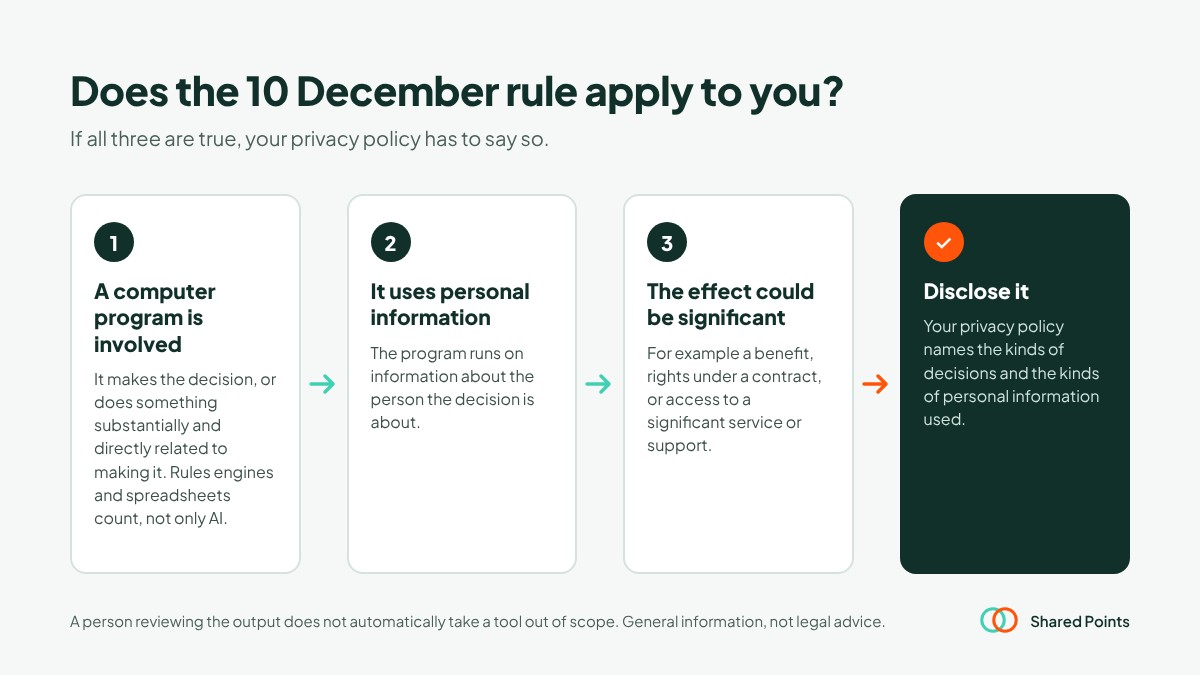
From 10 December 2026, Australian privacy policies have to cover automated decisions. If your organisation uses a computer program to make decisions about people, or to do something substantially and directly related to making them, and those decisions could significantly affect someone’s rights or interests, your privacy policy has to say so.
It sounds like a small wording change. In practice it is a discovery exercise. You can’t describe decisions you haven’t found, and most organisations have never listed them.
Here is what the rule asks for, what tends to be missed, and what you can realistically get done before the date.
What your privacy policy has to say
The new requirements sit in Australian Privacy Principle 1, added by the Privacy and Other Legislation Amendment Act 2024. Your privacy policy has to describe:
- the kinds of personal information used by the computer programs involved
- the kinds of decisions made solely by those programs
- the kinds of decisions where a program does something substantially and directly related to making the decision
The Office of the Australian Information Commissioner (OAIC) published updated guidance on 30 September 2026. It does not expect technical detail, and you can group decisions into categories. Separate processes with different outcomes should be described separately.
It is wider than AI
The rule talks about computer programs, not artificial intelligence. Rules engines, scoring tools, eligibility checks and even spreadsheets can be in scope.
So can software you buy. If you have arranged for a vendor’s program to make or support these decisions, the disclosure is still yours to make. Ask each vendor a plain question: what decisions does your product make about our customers or staff, and on what information?
A person in the loop doesn’t settle it
Many teams assume a tool is out of scope because a person makes the final call. The OAIC guidance doesn’t accept that on its own. It looks at how much the person relies on the output, how often they override it, and whether the tool is advisory or effectively decides.
If the program’s output is a material input to the decision, treat it as in scope unless you can show otherwise, and write down why.
What counts as significant
The Act gives examples of decisions that may significantly affect someone’s rights or interests:
- a decision under a law to grant or refuse a benefit
- a decision that affects rights under a contract, agreement or arrangement
- a decision that affects access to a significant service or support
Health, housing, finance, employment and utilities are the obvious places to look. A product recommendation is probably not significant. A declined application, a changed credit limit or a suspended account probably is. Either way, record your reasoning. That note is part of your evidence.
What to do in the next six weeks
- List the systems that make or support decisions about customers, staff, applicants or members. Include vendor platforms.
- For each one, write down the decision, who it affects and the kinds of personal information it uses.
- Decide whether the effect could be significant, and record why.
- Name an owner for each system.
- Give your lawyer the list and ask for wording that matches it.
- Record who approved the final wording and when, and set a date to review it.
If time runs short, do the first three steps for the systems that clearly matter, publish accurate wording for those, and record a plan to finish the rest.
What good evidence looks like
If a regulator or a large customer asks how you decided what went into your disclosure, you should be able to show them a register of systems, a short note on each one saying why it is or isn’t in scope, the name of the person who signed it off, and the date.
That is what an auditor asks for first. It is also what protects you if someone questions the wording later.
Talk to a lead auditor
We run free 30 minute calls on the 10 December change. Bring a rough list of the systems that make or support decisions about people. A lead auditor goes through it with you and tells you which ones are likely in scope and what to do first.
Book a free call, or read about Glasshouse, our AI governance package.
General information, not legal advice. Your lawyer should finalise any privacy policy wording.